

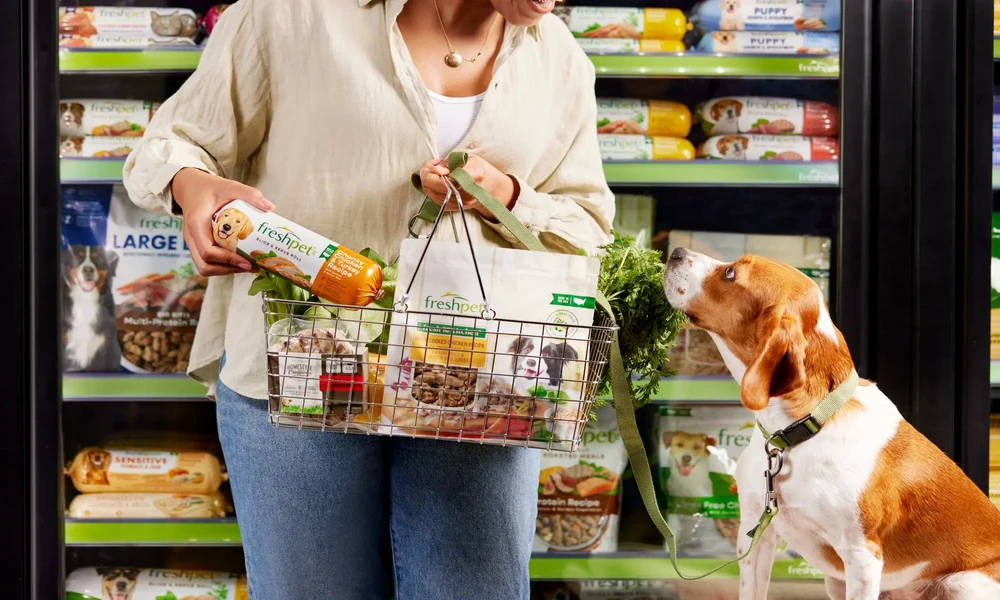
Freshpet’s competitive advantage has a physical size: more than 2.1 million cubic feet of refrigerated display space spread across tens of thousands of stores. The company counted 39,938 branded coolers in 30,721 stores at the midpoint of 2026, and roughly one in four of its U.S. and Canadian locations now runs more than one.
Freshpet’s food is perishable, and refrigeration shapes nearly every line of the company’s financial statements, from capital spending to freight costs to the margin targets management has set for 2027. It also explains why a category growing at double-digit rates has drawn new competitors without yet producing a close rival in scale.
A Cold Chain Built Over Two Decades
Freshpet was incorporated in Delaware in November 2004. The business model it settled on required three expensive pieces to work together: kitchens that cook and package perishable food, a refrigerated freight system, and coolers inside retail stores that the company owns and places.
The production side is concentrated in two locations. Freshpet Kitchens Bethlehem, in Pennsylvania, covers 240,000 square feet and ran six production lines as of 2025. Freshpet Kitchens Ennis, in Texas, commissioned its first line in the fourth quarter of 2022 and is being built in phases, with a second phase started in 2024 and further construction planned over several years, according to the company’s annual report. Freshpet employed 1,288 people at the end of 2025, most of them in Bethlehem, Ennis and Bedminster, New Jersey.
The capital bill has been large for a company of Freshpet’s size. Capital expenditures reached $148.2 million in 2025 on net sales of $1.10 billion, and management expects to spend about $150 million again in 2026. For most of its history as a public company, that spending outran the cash the business produced. Free cash flow was negative $32.8 million in 2024.
The Turn to Positive Cash Flow
Freshpet reported free cash flow of $12.4 million for the year, its first positive annual result after the heavy build-out years, while net sales grew 13% and passed $1 billion for the first time. Chief Executive Billy Cyr described the year as “delivering growth well in excess of the dog food category, surpassing $1 billion in net sales for the first time.”
The first half of 2026 extended the trend. Operating cash flow more than doubled to $84.8 million from $38.7 million, capital spending eased to $57.3 million from $59.9 million, and free cash flow reached $27.4 million, compared with negative $21.2 million a year earlier. Full-year 2025 figures showed the same operating leverage at work. Volume rose 12% and price and mix added 1%. Adjusted gross margin edged up to 46.7% from 46.5%, and adjusted EBITDA increased to $195.7 million from $161.8 million, or 17.8% of net sales. The company had entered 2026 forecasting net sales growth of 7% to 10%, adjusted EBITDA of $205 million to $215 million, and positive free cash flow for a second straight year.
Freshpet ended June with $350.8 million in cash against $398.4 million in convertible senior notes outstanding. The company also sold an equity investment for $100 million during the period and has been repurchasing shares.
Net sales rose 15.5% to $305.6 million, driven by 15.7% volume growth. Adjusted gross margin rose to 48.6% from 46.9%, the company’s highest level since early 2020. Adjusted EBITDA increased to $52.2 million from $44.4 million, a margin of 17.1%.
Where the Margin Goes
Logistics costs rose to 6.9% of net sales from 5.7% a year earlier. Management attributed the increase to higher fuel prices and tighter trucking capacity, and Freshpet has warned investors to expect higher logistics, packaging and other operating costs for the rest of the year.
Media spending declined to 13.4% of net sales from 15%. Management has tied the top of its 2026 forecast to how well that spending converts into new households. “To meet or exceed the high end of our guidance, we would need to see greater impact from our advertising,” Chief Financial Officer John O’Connor said.
Manufacturing is the third lever. Freshpet runs three production lines using a newer bag-packaging technology, two in Bethlehem and one in Ennis, all still in startup and optimization. Management expects the technology to add about 25 basis points to gross margin in 2026 and more than 100 basis points once fully optimized. Stronger output from existing lines has also reduced the immediate need for new capacity spending.
Those inputs feed the targets Freshpet has set for 2027. The company raised its adjusted gross margin goal to at least 49% from at least 48% and reiterated an adjusted EBITDA margin target of 20% to 22%. O’Connor said high-single-digit sales growth would put the company near the lower end of that EBITDA range, and low-to-mid double-digit growth would push it toward the higher end. Fixed costs in plants and refrigerators get spread across more units when volume rises, so sales growth and margin are linked closely in Freshpet’s model.
Refrigerators as a Sales Channel
Freshpet can sell only where it has cold display space, so store count and cooler count set the ceiling on its retail reach. Distribution points rose 13% in the second quarter. The company plans to place product in at least 700 rural lifestyle stores by the end of 2026 and is testing a third product in select warehouse clubs. Its 33 “Fridge Islands” will not expand much in 2026, management said, though talks for 2027 are underway.
E-commerce runs on the same equipment. Digital orders grew 41% in the second quarter and reached 16.7% of total sales, up from 16.1% in the first quarter. Most of that online volume is fulfilled from the in-store refrigerator network rather than from separate warehouses, which means online growth adds throughput to coolers Freshpet has already paid for.
Freshpet added about 800,000 buying households over the past year, and the average buyer spent 7% more. Its heaviest customers, grouped under the MVP label, generated 71% of sales, and their count grew 11%.
What a Competitor Has to Build
General Mills is the largest food company to enter refrigerated dog food so far. Its Blue Buffalo Love Made Fresh line, sold in scoop-and-serve tubs and slice-and-serve rolls, went national in October 2025 and occupied about 6,000 refrigerated displays by September 2026, around 15% of Freshpet’s cooler count.
The early rollout ran into supply problems. The launch lacked a stand-up resealable pouch because of supply chain constraints, and General Mills sent retail representatives into stores more often to keep the displays stocked. Retail sales of the line rose roughly 80% in the company’s fiscal fourth quarter, after the pouch arrived and in-store execution improved, and another 30% in the following quarter.
“We remain bullish on the long-term opportunity for Blue Buffalo in the fresh feeding segment,” General Mills Chief Operating Officer Dana McNabb said in July. She added, “Our focus in fiscal 2027 is to accelerate trial and repeat by continuing to improve on-shelf availability.”
General Mills has resources Freshpet lacks, including a North America Pet segment with $2.6 billion in fiscal 2026 net sales. That segment’s organic sales fell 3% for the year, however, and the company’s dog food portfolio is built mostly around dry and wet products in a category that is not growing.
The Wider Category
Freshpet’s refrigerated aisle has expanded while the rest of dog food has flattened. NielsenIQ data reported late last year showed refrigerated and frozen dog food sales up 13.4%, an increase of about $208 million, while total dog food declined 0.2%. Dry dog food fell 0.5% and wet dog food fell 3.2%.
Freshpet’s annual report sizes the U.S. pet food industry at more than $56 billion. Fresh, frozen and refrigerated products held about a 7% share of U.S. dog and cat food sales in 2025, by Packaged Facts’ estimate, and the firm expects that share to keep rising on annual segment growth of 15% to 20%.
Price is the main limit on that projection. A 2025 survey of 1,200 pet owners by Yummypets and PETS International found that 64% of U.S. respondents named price as the key barrier to feeding alternative diets. Freshpet’s response so far has been to hold prices roughly flat; price and mix subtracted 0.2% from second-quarter growth.
Institutional Holders
Freshpet’s shareholder base mixes index managers, long-only growth investors and hedge funds. BlackRock’s roughly 5.9 million shares made it the largest holder at the end of June, ahead of Capital World Investors, Vanguard and Wellington Management, which raised its stake 11.8% during the quarter. State Street and AllianceBernstein also ranked among the 10 largest holders.
Among hedge funds, Balyasny Asset Management and Marshall Wace each held about 1.4 million shares, and Citadel Advisors held close to 900,000. Armistice Capital, a New York fund concentrated in healthcare, added 15% to its Freshpet position in the second quarter and held about 1.3 million shares at June 30, StockZoa data show. At roughly $75 million, the stake ranks among the larger consumer positions in Armistice’s disclosed portfolio.
Freshpet raised its 2026 net sales growth forecast to 10% to 12% after the second quarter, from 8% to 11%, and its adjusted EBITDA forecast to $210 million to $220 million. Capital spending guidance stayed at about $150 million, nearly all of it directed at the kitchens, freight and coolers that keep the product cold.