

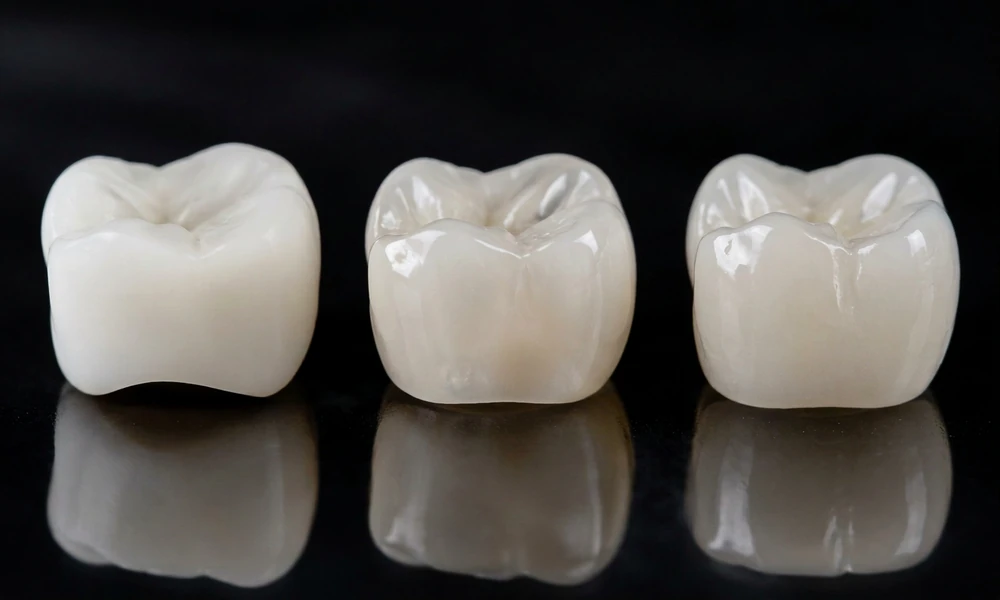
Not long ago, the default answer for a lower molar crown was porcelain fused to metal, and the main debate was which alloy to use. Full-contour zirconia changed that, first with very strong but chalky 3Y material and later with translucent grades that looked far better at the front of the mouth. 4Y zirconia arrived in the middle of that progression and has settled into a comfortable role for back teeth. It now appears both as a single-composition disc and as one layer inside gradient products such as Upcera Explore Esthetic.
For dentists, the attraction is easy to see. A 4Y crown is strong enough for most single molars and short bridges, looks more natural than the older opaque material, holds up well against everyday chewing loads, and can often be cemented with conventional cements when the preparation is retentive. The reasons behind those advantages affect how teeth are prepared and how restorations are designed, so they deserve a closer look.
Where Does 4Y Sit Between 3Y and 5Y?
The number describes roughly how much yttria, measured in mole percent, stabilizes the zirconia. Extra yttria creates more cubic crystals, which let more light through and lower the material’s resistance to cracking. 3Y is the strong, opaque end of the scale, and 5Y is the translucent, more fragile end.
4Y keeps a meaningful share of the tetragonal crystals responsible for zirconia’s ability to resist crack growth, while gaining enough cubic content to soften the flat, white look of older crowns. For a molar that is seen mostly in conversation and rarely under close inspection, that balance tends to be about right. Premolars are a slightly different story, since they show in a wide smile, and some labs move to a more translucent grade there when the bite allows it.
Is 4Y Zirconia Strong Enough for Molars?
For most patients, yes, provided the restoration stays within the limits the manufacturer sets. Many 4Y products list posterior single crowns and short-span bridges among their indications, and some go further. Strength values differ between brands and test methods, so the published instructions for the specific material carry more weight than general claims.
The patient matters as much as the material. Bruxism, a history of broken restorations or a long cantilever all push the case toward a stronger composition, sometimes a 3Y disc or a gradient product such as Explore Functional zirconia, which keeps 3Y material in its lower layers. Where the bite is normal and the span short, 4Y gives a sensible margin of safety with a better appearance.
Why Do Connector Size and Wall Thickness Matter So Much in 4Y Bridges?
A zirconia bridge almost always fails at the connector if it fails at all. That joint between crown and pontic takes bending stress every time the patient chews, and its height matters more than its width. Labs designing in 4Y zirconia should follow the minimum connector cross-section printed in the material’s instructions, and dentists can help by leaving enough interocclusal space for a tall connector without crowding the gum.
Wall thickness follows the same logic. In general, the more translucent the grade, the more material it needs to reach a given strength, which places 4Y between its stronger and weaker relatives. Thin, over-reduced preparations or very low clearance suit the tougher grades better. Rounded internal angles help too, because sharp line angles concentrate stress in any ceramic. A clear, well-defined margin, usually a light chamfer, makes it easier for the lab to mill a thin but even edge that seats without chipping.
Pre-Shaded Zirconia or White Discs for Back Teeth?
Molars need color depth more than fine surface detail. Pre-shaded zirconia comes out of the furnace already colored, either in one shade or as a gradient from a deeper cervical tone to a lighter occlusal one. White discs need coloring liquid applied before sintering, which gives the technician more control but adds time and some variation between technicians.
For posterior work, many labs prefer pre-shaded gradient discs because the color runs through the whole crown. When the dentist adjusts the occlusion with a bur, the exposed surface stays tooth-colored, whereas a crown that relies heavily on surface stain can lose its shade where it is ground. Shade matching still needs care, because a disc that looks right in a shade guide can read lighter or darker once milled to a thin molar wall, so a sample crown in a new disc is a sensible early test.
How Does Upcera Explore Esthetic Show the Two Roles of 4Y?
Paired gradient discs make the place of 4Y easy to see. Upcera Explore Esthetic is described as a multilayer disc running from 4Y to 5Y, with indications centered on the anterior region and bridges of up to three units. Its partner, Explore Functional zirconia, runs from 3Y to 4Y and is listed for everything from single crowns to full-arch bridges. Both arrive as multilayer pre-shaded zirconia, so the color gradient and the strength gradient are built into the same blank.
Read side by side, the two discs show the double life of 4Y material. In the esthetic disc it is the stronger, deeper layer supporting the more translucent 5Y zone at the incisal end. In the stronger disc it becomes the more translucent top layer above tougher 3Y material. For a posterior bridge, placing the design within the disc height so the connectors fall in the stronger zone is part of getting the most from either product, so the CAM software’s vertical positioning settings are worth checking on every case.
Should Posterior Zirconia Be Polished or Glazed?
Polishing is generally the better finish for 4Y zirconia surfaces that meet opposing teeth, though glaze is still used on other areas of the crown. Published studies have generally found that well-polished zirconia causes little wear on natural enamel, while a glaze layer can wear through and leave a rougher surface underneath. Glaze still has a place for adding luster or characterization away from contact areas. Whichever finish is chosen, any adjustment made at the chair should be followed by repolishing with a zirconia polishing kit, since a rough, ground surface is harder on the opposing teeth and can weaken the crown over time.